



















When it comes to health and beauty regimes, we know that lasting results happen over time, and trying to fast-track change by taking on too much too soon can be counterproductive.
You wouldn’t attempt to lift the heaviest weight at the gym on your first day, and you wouldn’t smother your face with an entire tub of face cream expecting to see instant results. The same principle applies to LED light therapy—it's not about overwhelming your body with maximum power at once but rather about consistent, measured application over time.
The word "power" is usually associated with better and faster results, but with LED light therapy, studies have shown that a lower power over a longer time tends to produce better results.
Finding the right LED power
When it comes to LED light therapy, it’s about balancing all the factors that impact results—wavelengths, coverage, and power over time—to create the most effective amount of light for your skin.

The pillars of LED results: Optimising power for maximum efficacy
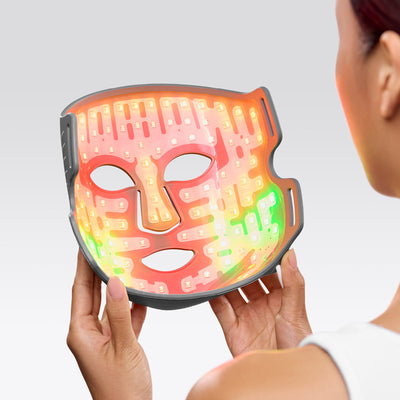
When it comes to effective LED light therapy, there are 3 pillars that determine the effectiveness of sessions. Let’s break down these pillars, what they mean for your skin, and how we’ve optimised them in our CurrentBody Skin Series 2 LED Mask.
Wavelength precision and quality
Precise wavelengths of light are proven in clinical studies to be the most effective for supporting healthy skin. The more precise the wavelength, the better the results.
We created Veritace®, our unique end-to-end testing system to ensure that every LED in our devices emit the most clinically proven wavelengths with unmatched precision, for guaranteed quality and results you can trust.
Coverage of LEDs
The way light is spread across the skin matters, with even light distribution key for achieving the best results. Even small adjustments in the number of LEDs, placements and distance from the skin can significantly impact the performance.
Our Series 2 Mask has been tested on 1,000s of faces, with a flexible Best-Fit shape to ensure all areas of your face and chin are evenly exposed to the light. Its multiway strap ensures the mask stays in place during sessions, maintaining consistent contact and even coverage across the skin.
Balanced LED power over time
Power (also commonly referred to as ‘irradiance’) is important, but more power doesn’t necessarily mean better results. As mentioned, it is common knowledge in the scientific evidence that low-level light therapy (LLLT) works best when delivered at lower power over a longer period. Too much power in a short time can overwhelm the skin, while too little may not be effective.
With a balanced power output and with short, 10-minute sessions, this upgraded mask is both effective and convenient, fitting easily into skincare routines.
By optimising the 3 pillars of LED results, The Series 2 mask delivers full-face coverage for more even results when compared to a traditional flexible LED mask.

The limitations of measuring power: What studies can’t tell us
When it comes to LED light therapy, it is widely accepted that it is not currently possible to measure the precise amount of energy absorbed by the skin during sessions.
Most studies have measured power density using a tool called a spectrometer, but this only tells part of the story, as it is only capable of measuring the power emitted at a single point on an LED mask, without accounting for all the other factors that affect how much light your skin actually absorbs, including:
Distance from the skin
In LED masks, the proximity of the light to the skin makes a significant difference in how the light is absorbed compared to LED panels (which are the devices commonly used in scientific studies), typically set further away from the skin. However, this isn't captured in a simple power density reading.
LED placement
The number and arrangement of LEDs on a mask impact how evenly the light is distributed across the skin.
In conclusion, LED light therapy should be treated like any other health and beauty regime, requiring a consistent and balanced approach for lasting results. Achieving optimal results relies on balancing the 3 key pillars of LED results: wavelength precision, even coverage, and balanced power over time.
These factors work together to ensure the skin absorbs light most effectively, providing safe and measurable benefits over time. By focusing on these pillars rather than chasing higher power, LED therapy can deliver effective, long-term improvements in skin health.